Parts of a Saree: Body, Borders, Pallu and Inner End
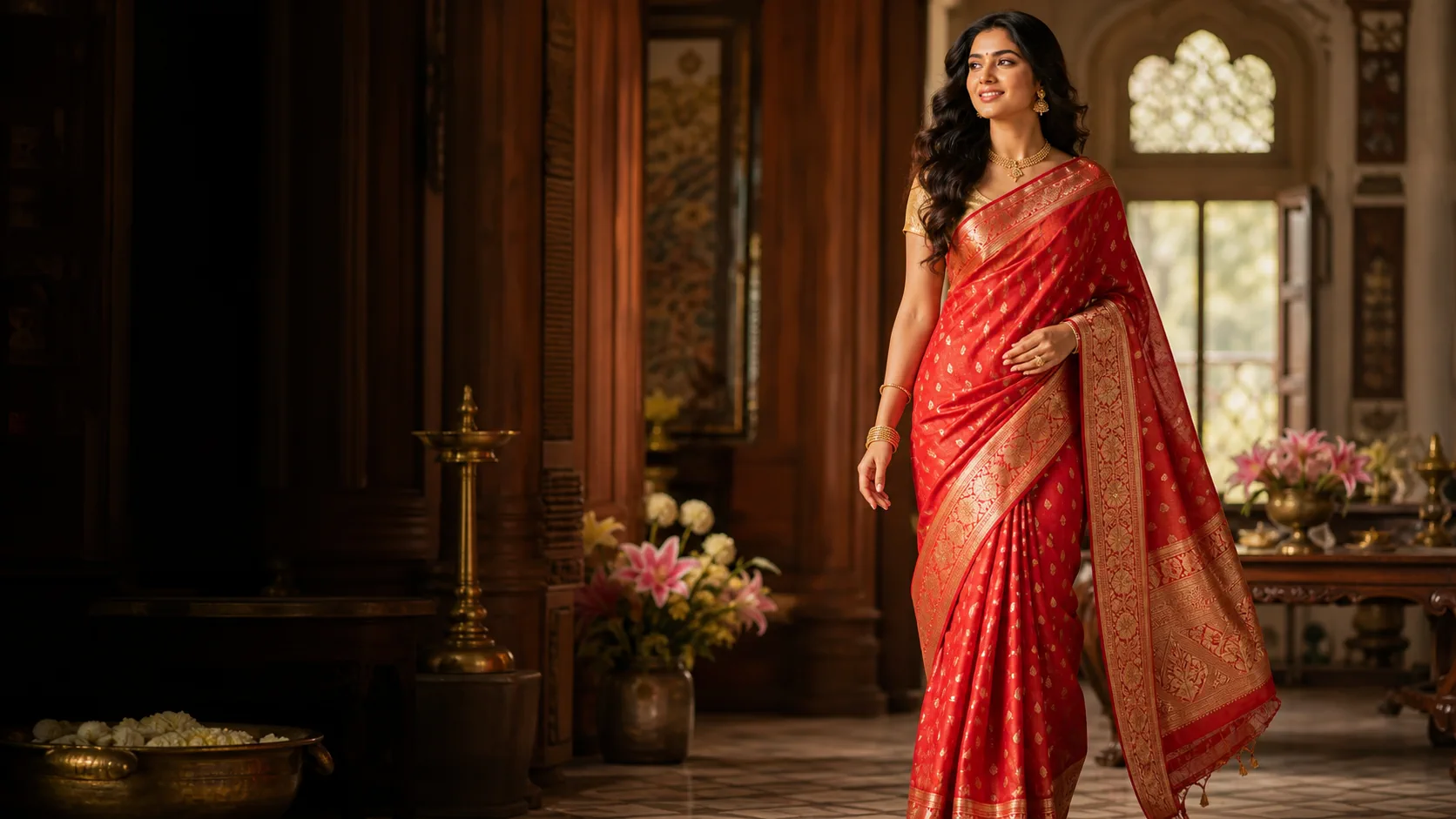
শাড়ির অঙ্গচেনা: জমি, পাড় ও আঁচল
Learn the main parts of a saree—body, lengthwise borders, pallu or anchal, and inner end—and how to check their motifs and proportions in photos.
What are the main parts of a saree?
The main parts of a saree are the body or field, the two lengthwise borders, the pallu or anchal, and the starting or inner end. Motifs may change in scale, spacing, direction or density across these areas, creating the saree’s complete visual arrangement.
The body forms most of the wrap and front pleats. The borders frame the long edges, the pallu is the terminal section carried over the shoulder, and the inner end is usually tucked inside. Knowing this map helps you check whether product photographs show the full design rather than one attractive detail.
Body or field: the main expanse
The body, also called the field, is the largest area of the saree. It may be plain, striped, checked or covered with repeated motifs. Because it forms most of the wrap and the front pleats, its motif scale and spacing strongly shape the saree’s appearance when worn.
When viewing a saree online, compare more than one photograph of the body. Check whether the motif scale and spacing remain consistent. Also remember that colour may appear different under warm indoor light and cool daylight; a careful listing should describe the visible colour without making unconfirmed claims about dye or fibre.
Lengthwise borders: the two framed edges
The borders run along both long edges of the saree, framing the hem and continuing toward the pallu. Read them by looking at their width, number of bands, motif direction and whether the two edges match or intentionally differ.
A border close-up shows construction, but not proportion. Pair it with a full view of the saree so a narrow line is not mistaken for a broad border. Photographs of both edges also help confirm continuity and reveal any deliberate difference between them.
Pallu or anchal: the shoulder end
The pallu is the terminal decorative section worn over the shoulder. In Bengali conversation, আঁচল or anchal names this expressive end of the saree. Its bands, motifs or denser ornament often make it visibly distinct from the body.
Because the pallu is a separate terminal panel, it should not be represented by simply repeating the body pattern. If a product listing shows only a folded glimpse, ask for an open photograph that reveals the entire pallu and the transition from body to end panel.
Inner end and motif map: the details between
The starting or inner end is usually tucked inside and may carry less decoration. It is not always visible in model photographs. If it has not been photographed, its appearance should be described as unseen rather than guessed.
Then trace the motif map across the whole saree: count repeated elements, compare their spacing and orientation, and notice where ornament becomes denser. Together, these details act as a visual fingerprint for the actual saree and help distinguish a faithful product view from an inaccurate reconstruction.
A quick way to read saree photographs
Start with a full-length view to identify the body, both borders and the pallu. Move to close-ups to check motif scale, edge construction and the transition into the terminal panel. Finally, look for the inner end or confirm that it was not shown.
This sequence connects detail to proportion. It also gives you a practical checklist before buying: a clear body view, both long edges, an open pallu, close-ups with scale, and honest identification of any area that remains unseen.
What are the main parts of a saree called?
The main parts are the body or field, two lengthwise borders, the pallu or anchal, and the starting or inner end. Motif placement connects these areas into one design.
Is the pallu the same as the saree body?
No. The body is the main expanse forming most of the wrap and pleats. The pallu is the terminal section worn over the shoulder and often has distinct bands, motifs or denser ornament.
What is the difference between pallu and anchal?
In this guide, pallu names the decorative terminal section carried over the shoulder, while আঁচল or anchal is the Bengali term used for that expressive end of the saree.
Why should both saree borders be photographed?
Photographs of both long edges help confirm border width, continuity, motif direction and whether the upper and lower edges match or intentionally differ.
What should I check in online saree photos?
Look for a full body view, both lengthwise borders, an open pallu, close-ups that show scale, and a clear note when the tucked inner end or another area has not been photographed.