A Map You Can Wear: Reading Region and Place Through Sarees
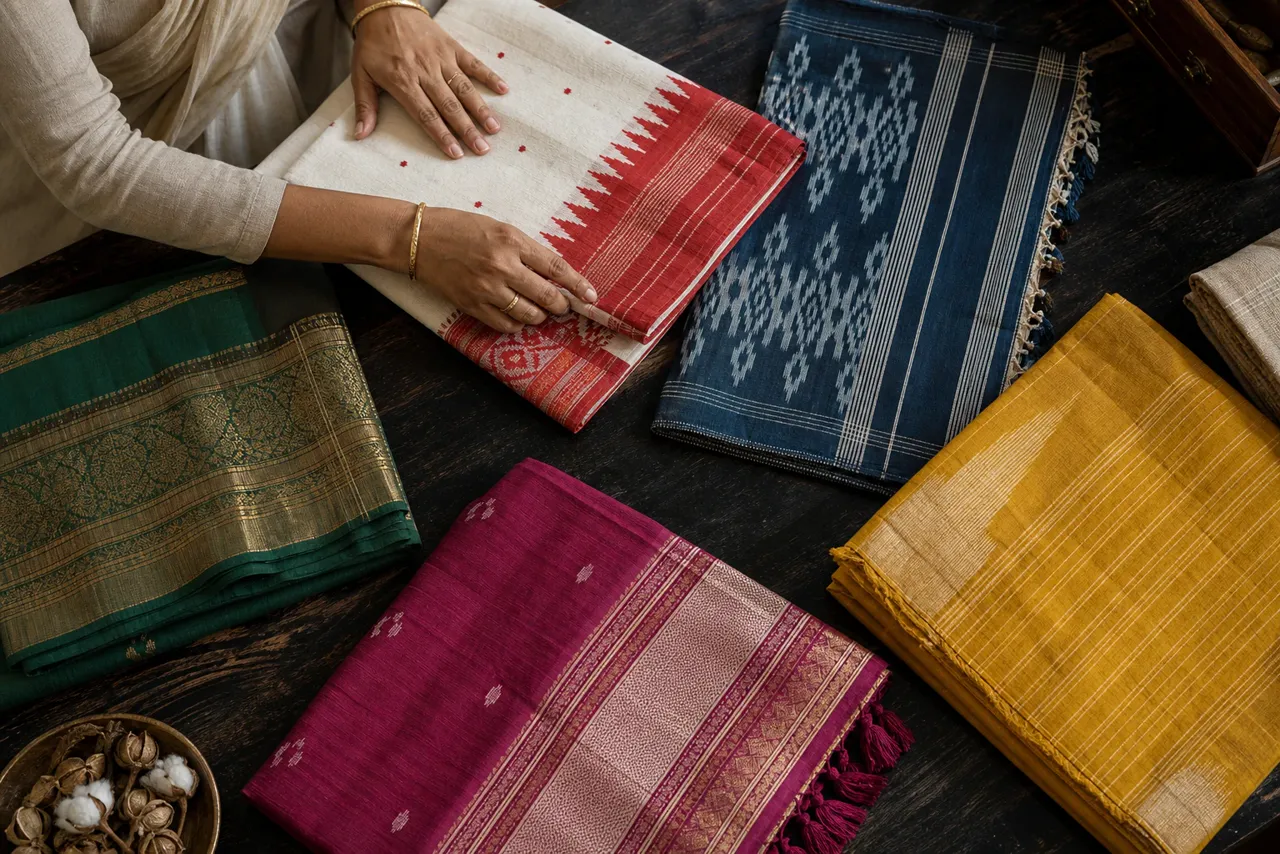
পরনের মানচিত্র: শাড়িতে অঞ্চল ও ঘরের পরিচয়
Explore regional sarees of India through colour, motif, structure and drape without reducing living textile traditions to convenient labels.
Geography enters cloth in many ways
A region can shape a saree through available fibres, climate, trade, ritual, local aesthetics and the knowledge held by weaving or printing communities. Over time, combinations of colour, border, motif and structure become recognisable.
This is why sarees are often described as a map of the subcontinent. Yet the map is neither fixed nor simple. Makers move, markets influence one another, techniques travel and contemporary designers reinterpret older vocabularies.
Bengal and the delicacy of motif
Bengal's textile history includes fine cotton traditions, Jamdani patterning, striped and checked sarees, and many local variations. The anchol often becomes a particularly expressive area, carrying a different visual density from the body.
Names matter. Jamdani refers to a specific weaving tradition and should not become a loose synonym for every delicate floral saree. A truthful product page distinguishes a verified identity from a visual resemblance.
Temple, river, field and city
Across India, textile descriptions frequently draw on the built and natural world: temple forms, flowers, birds, rivers, fields and geometric order. These references help us read a design, but they are not automatic proof of origin.
A motif may travel much further than the technique that first made it famous. The most respectful approach combines visual appreciation with documented provenance: look closely at what is present, then ask what is known.
Drape is also regional knowledge
Place appears not only in the textile but in the way it is worn. Different drapes respond to work, movement, ceremony and ideas of presentation. The same length of cloth can create remarkably different silhouettes.
These styles are living practices, not costumes frozen in the past. Families adapt them, individuals combine them, and new generations find their own balance between familiarity and experimentation.
Shop with an open, careful eye
Regional language can deepen a purchase when it is accurate. It can also become empty marketing when every motif is assigned a famous name. Choose sellers who show complete photographs, separate fact from observation and acknowledge uncertainty.
A saree can connect us to place without becoming a stereotype. Read it slowly: first as cloth, then as evidence, and finally as one chapter in a much larger textile geography.
Does a regional motif prove where a saree was made?
No. Motifs and colours travel, so verified origin requires reliable provenance rather than visual similarity alone.
Why are some saree names formally registered?
Geographical Indications can identify goods connected to a defined place and recognised qualities or reputation; consult the official register for current details.