Before the Saree Reaches You: Seeing the Hands Behind the Loom
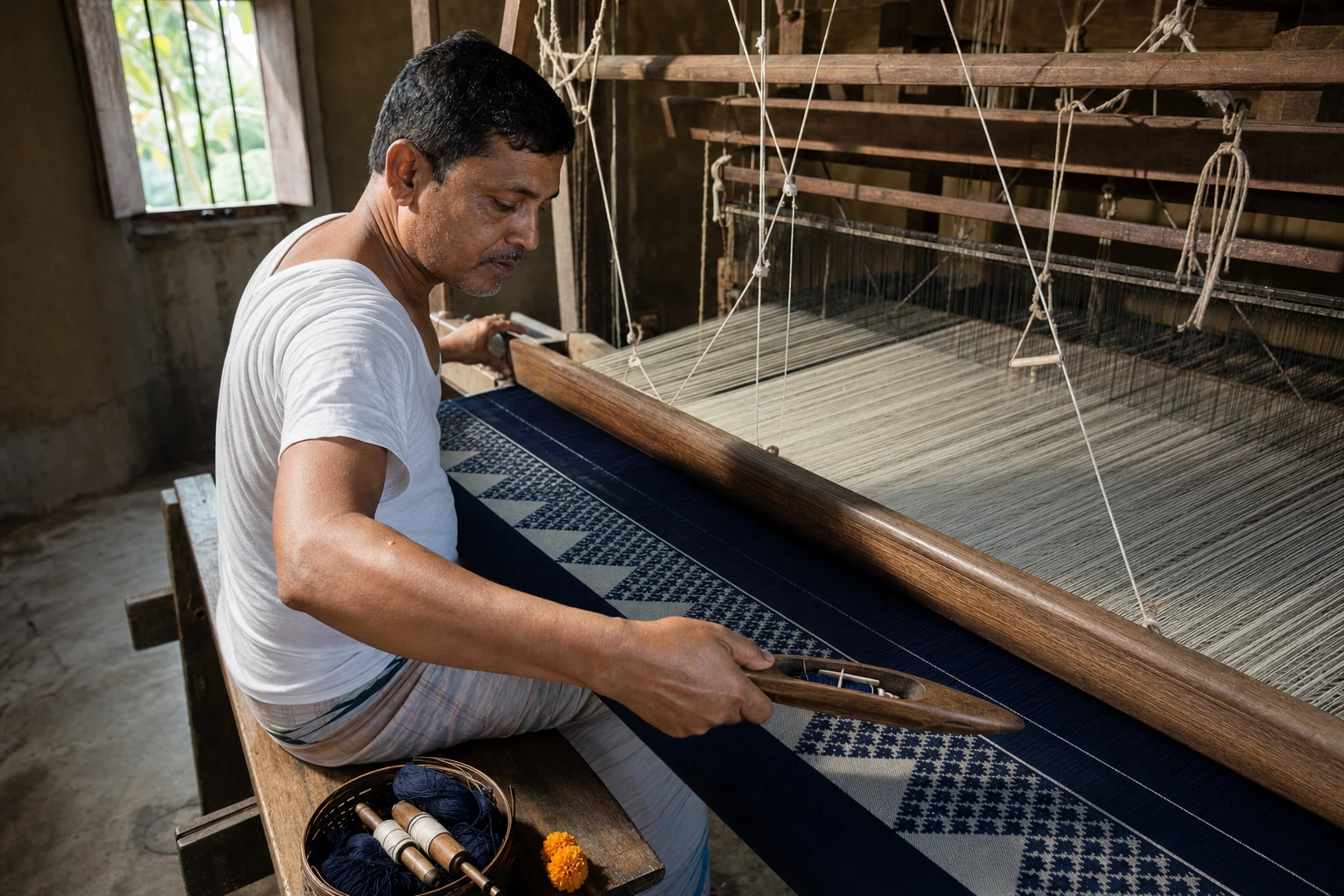
শাড়ি আপনার কাছে আসার আগে: তাঁতির হাত চিনে নেওয়া
Meet handloom saree makers through the patient preparation, skilled decisions and human time behind cloth, while separating fact from myth.
Finished cloth hides its own labour
A saree arrives folded, measured and ready to wear. That neatness can hide how many decisions came before it: selecting and preparing yarn, arranging colour, setting the loom, maintaining tension, building motifs and correcting small problems before they travel further through the cloth.
Not every saree is made in the same way, and a photograph alone cannot prove a specific technique. Yet one principle remains important: textile skill is work. It deserves accurate naming and respect beyond decorative language.
Time is part of the textile
Hand processes do not follow the speed of automated production. Repetition must remain steady, and a small error can affect later sections. The maker's attention becomes part of the finished rhythm even when the buyer cannot see every movement that produced it.
This does not mean every hand-produced textile should be romanticised. Makers need reliable livelihoods, safe working conditions and honest commercial relationships, not only admiration. A story about craft is incomplete when it celebrates beauty but ignores labour.
Ask for evidence, not mythology
Words such as handloom, handmade, artisan and heritage carry emotional power. They should also carry proof. A responsible listing separates confirmed facts from visual observations and does not assign a region, fibre or technique simply because a pattern resembles a familiar tradition.
Buyers can ask who supplied the saree, whether its making method is documented and which claims are verified. Honest uncertainty is better than an elaborate origin story invented to increase value.
Irregularity and intention
Some hand processes create small variations in spacing, edge or texture. These can be evidence of human making, but not every irregularity proves handloom and not every flaw should be celebrated. Context matters.
Study the whole saree. Compare repeated motifs, look at the reverse where available, and read seller documentation. The aim is not to become an expert from one photograph, but to become a more attentive buyer.
Let the maker remain visible
When craft is described truthfully, the saree becomes more than an anonymous surface. The maker's skill remains connected to the product, and the buyer can understand why time, knowledge and careful production have value.
At Anchol Katha, we prefer a verified fact to a beautiful fiction. Respect for the hands behind the cloth begins with saying only what we know.
Can I identify a handloom saree from one photograph?
Not reliably. Visual clues can support an observation, but construction and origin claims need documentation or informed physical examination.
Are all irregularities signs of handloom?
No. Variations can have several causes and should be interpreted alongside provenance, structure and seller documentation.